
Membership
Membership in Klavern 136 is, on its face, difficult to determine. As of the writing of this page, none of the grandchildren of Denton's many klansmen have come forward with membership cards sewn into the walls of their historically registered homes on Oak or Hickory street. The ratio of officially licensed robes and ephemera strewn about the county in 1924 to fraternal and political organizations who have donated hooded robes from their near-abandoned storage units is ∞ to 0. Further still, for the thousands of people lining the sidewalks of Denton's square, eagerly watching small white horses and electric crosses shuffle by, not one single spectator's curious great-grandchild has brought forth a photograph, drawing, diary entry, letter, or note that describes Denton's klanish festivities. Unfortunately for the present, not-so-distant relatives' relationship to the Ku Klux Klan is a liability for which few are willing to pay the social price.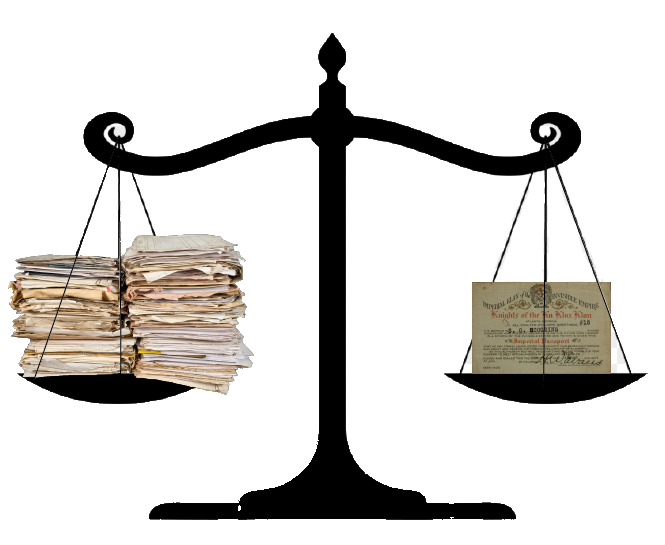
Yet, in the absence of a near-fantasy level (or, put another way, without surpassing the legal standard of "beyond a reasonable doubt" to arrive at "certitude" before we, mere mortals, are permitted use of the label 'klansman' for men who have long since passed), we can still see the hooded shadows of history dance across the walls of the courthouse-on-the-square museum. To decipher the silenced past, let's begin with what we do know about Denton's Klavern 136 and expand outward. 
Unraveling Denton's Secrets
The political power of the Ku Klux Klan was nearly as attractive as its moral tenets to Denton County residents. Alvin M. Owsley, a Denton politician, was mentioned as a possible running mate for William G. McAdoo at a meeting of the Dallas ‘McAdoo for President’ club on July 14, 1923. His nomination was urged by a member who stated, “we must nominate a ticket composed of men whose sympathies and interests are known to be with the people.” This was printed gleefully in the Fort Worth Klan Newspaper The American Citizen and William McAdoo ran for President as the official candidate of the politically active Ku Klux Klan.
Parade Participants
Part of the Klan's rationale for pushing Owsley to run for Vice President was his position as Commander of the national American Legion. At every Klan parade in Denton, waiting crowds were entertained by the American Legion Band as part of the official program. While official statements by Owsley and the American Legion denied any and all relationship with the Ku Klux Klan, membership denial was so widespread William J. Simmons once referred to himself as the only officially-recognized member of the Klan. Further, complete structures were put into place which aided denial of membership without committing perjury in a court of law. Linda Gordon describes the official procedure in Oklahoma, "and perhaps elsewhere too" in crystal clear terms:
"Klan membership was automatically suspended for any man called for jury duty, so that he could deny it and not be excluded for bias."
Explore items related to the American Legion and the Ku Klux Klan in Denton County
Recorded, official participation in the Klan parade, whether as a masked marcher or Klan-sanctioned speaker, is a clear indicator of Klavern membership. Mayor H. V. Hennen spoke at every Kluxer rally in Denton County during his tenure of office and, while Dallas and Fort Worth assisted, both the City of Denton and Denton County provided special security (and permit) to the march. Denton City Secretary George Rucker was also listed by name as organizationally significant to the Klan parade in 1923. In January 1925, an official Klan speaker gave a lecture in the 16th District Court of the State of Texas in Denton, gushingly introduced by Mayor H. V. Hennen as a Methodist and 32nd Degree Mason, a trio of organizations with much shared membership.
Denton County Medical Society
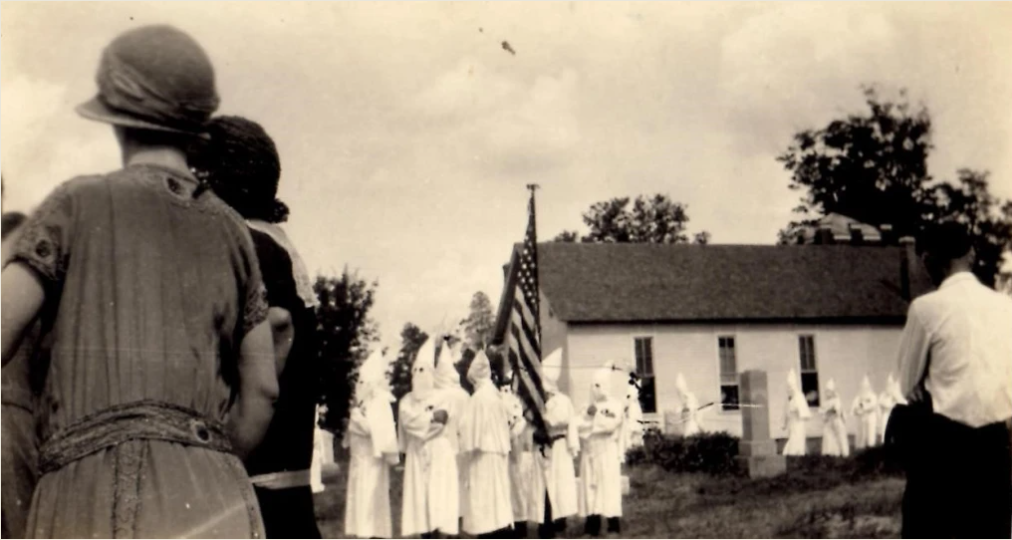
On October 20, 1922, Dr. W. G. Kimbrough received a Klan burial by eight hooded members of Klavern 136. The Klansmen placed a cross of roses with the letters KKK atop at his grave in Denton’s I.O.O.F. cemetery after they spent time in a place of prominence at his church funeral. Kimbrough was not the only member of Denton County Medical Society who also joined the Ku Klux Klan. Similar to Mayor Hennen, Dr. Horatio G. Fleming spoke at the Klan parade in 1923 and introduced the Klan lecturer to the audience while Dr. Priestly Lipscomb's wife was a founding member of the Women's auxiliary group, Women of the Ku Klux Klan (WKKK).
Letters to the Editor...of a Klan Newspaper
Citizens and business owners wrote to the American Citizen, a Fort Worth Klan newspaper, to express their dissatisfaction with the anti-Klan stance of the Chamber of Commerce or the Elks Lodge. One such writer was J. Fred Rayzor who, as owner of Alliance Ice Company and a member of the Denton Chamber of Commerce, withdrew from membership in the Chamber of Commerce in defense of the Ku Klux Klan. In October 1921, the Dallas-headquartered Texas Chamber of Commerce passed a resolution against the Ku Klux Klan due to its extralegal violence. In response, Rayzor wrote to the Chamber of Commerce on November 23, "In my report to the Southwestern Ice Manufacturers' Association in El Paso on November 17, as their representative to the Texas Chamber of Commerce, I advised that they discontinue relations with your chamber as a body." The Ice Manufacturers agreed and unanimously passed a resolution to withdraw from the Texas Chamber of Commerce. Rayzor explained his actions further in scorching terms:
”My action was occasioned by the sentiments expressed in your convention in October when you adopted a resolution condemning the Ku Klux Klan. I happened to be present at this meeting and after hearing the resolution read, the discussion and seeing the sentiment expressed by the vote, I wrote Mr. Mitchell, secretary of our association and told him that I had severed my relations with the Texas Chamber of Commerce...I am not a member of the Ku Klux Klan, neither would I be ashamed of it if I were.”
J. Fred Rayzor's father, James N. Rayzor, was also featured in a Klan publication, but the connection to direct membership is murkier.
Denton Record-Chronicle
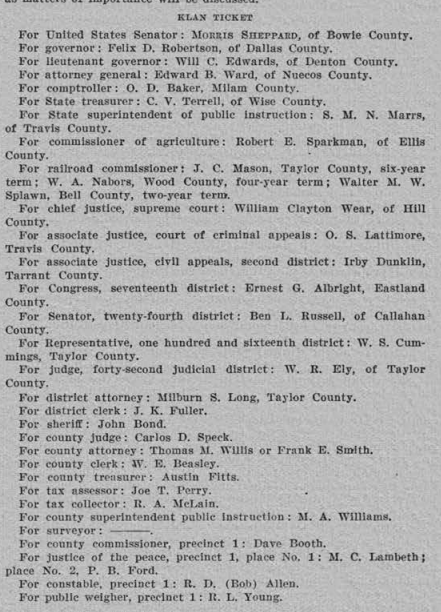
One of the tenets of Ku Kluxism is klanishness or, exclusively doing business with other klansmen. Businessmen joined the Klan to avoid boycotts, politicians to gain votes, and newspaper editors to ensure readers and advertisers. Will C. Edwards, the Editor-in-Chief of the Denton Record-Chronicle was the chosen Klan candidate for Lieutenant Governor in 1924. Edwards never denied his membership in the press, even when political pressure mounted against his campaign which, perhaps, cost him the election.
Newspaper editors were heavily incentivized to join the Klan due to the influence of the press on the actions of extralegal violence "in the service of justice." If the Ku Klux Klan rendered the de jure justice system impotent, the Klan itself became the de facto judge, jury, and executioner. But, let's take that a step further. How did the Ku Klux Klan know whom to target with their masked crusades? The same yellow journalism which dripped from the pages during the Spectacle Lynching Era were revived from klanish editors who orchestrated and obscured the violent and dehumanizing whitecapping perpetrated by members of the Second Ku Klux Klan.
Still, if an editor changed heart and attempted to disrobe his publication of its Invisible Empire sympathies, the price was high. In his World's Work exposé, Robert L. Duffas wrote, "A newspaper editor, in a Texas village, told an acquaintance of mine that he had joined the order when it was first organized, declared that he was now disgusted with it, but admitted that he dare not mention its numerous offences in his news columns."
Husbands of the WKKK
In Atlanta, the establishment of a woman's auxiliary Klan made financial sense to a Kleagle system running out of unaffiliated and unopposed white protestant men in Texas to sell membership. One major difference between the WKKK and its male counterpart is the lack of ritualized violence. In practice, the women who joined the WKKK of Denton County treated the organization as they did the United Daughters of the Confederacy, Maccabees, Rebekahs, or other female social organizations.

For example, in the coldest part of February 1925, the Klanswomen of Denton held a rummage sale to benefit the Dallas children's home "Klanhaven." On the same day, tucked into an article on fundraising for Jackson school, a rummage sale was also listed with specific women named as contacts: Mrs. H. C. Taliaferro and Mrs. Joe I. Evans.
Another tell-tale event of the Women of the Klan was in 1923 when the first WKKK chapter organized in Texas at Fort Worth. Eight Denton women traveled to Fort Worth the same evening as the initiation, six of whom were the guests of the same woman, Mrs. Elmo Sledd, wife of the Vice President of Fort Worth National Bank. The visitors were listed without their husbands as follows: H. F. Schweer, L. H. Schweer, P. Lipscomb, J. W. Sullivan, J. W. Simmons, and W. C. Edwards. A similar group went to see "Birth of a Nation" at its Fort Worth premier in 1915.
Mapping the Ku Klux Klan in Denton County
The logistics of a secret organization which threatened and murdered fellow citizens without investigation, charges, or conviction required either the participation or active silence of men and women in positions throughout the Denton County community. Those employed in communications were nearly as important as recruiting the Sheriff and his deputies.
Postmasters & Telephone Operators
On July 17, 1868, Freedmen's Bureau employee Joe Easley wrote a letter to Representative M. L. Armstrong, a supporter of Black rights in the Texas State House of Representatives. Easley, who lived in Sulphur Springs, Texas, sent the letter to The Daily Austin Republican rather than to Armstrong directly out of fear of interception by the Ku Klux Klan. Therein, Easley wrote:
"I am aiming to send this letter to Dallas, to have it mailed. It is impossible to have anything of the kind sent from this county by mail. The postmasters are all Ku Klux."
Fifty-five years later, the problem of the Klan and the post remained. The Governor of Arkansas became so overwhelmed with the actions of the Ku Klux Klan in 1922 that he petitioned the Department of Justice for help. J. Edgar Hoover contemporaneously reported, “The Governor has been unable to use either the mails, telegraph, or telephone because of interference by the Klan” and that, “local authorities are absolutely inactive.” In Houston, Klansmen tapped telephone wires, intercepted telegraphs, and spied at the post office. This information was then transmitted to the Sheriff’s Department who would respond through capturing the offender and placing them into custody. It was from this very custody that the accused were taken by the Klan under the cover of masks and darkness.
"Old Skip [Exalted Cyclops] ordered the telephone girl at Bastrop to stop all messages between that town and Mer Rouge, and, after she refused, the wires were cut."
-World's Work, 2 pg. 175
Baptists and Presbyterians

Down the street from the State Fairgrounds, in preparation for Klan Day at the State Fair of Texas on October 24, 1923, Dr. William Fred Galbraith published an advertisement in the Dallas-published Klan newspaper, The Texas American. Just over one year later, Galbraith was named as the pastor for First Presbyterian Church of Denton.
The First Baptist Church in Denton was organized in the Masonic Hall in 1858. William C. McClung was pastor from 1919 until 1931 and openly endorsed the Ku Klux Klan in Denton County. McClung frequently hosted events and conventions where pastors present had received Klan donations (this was a sign of pastoral support and usually membership as well). T. R. Bowles, pastor of the Baptist church at Stony is another example of a Klansman at the head of a Denton County Baptist Church. The pastor from Roanoke also accepted Klan funding from masked men mid-sermon and at the thirty-seventh annual session of the Denton County Baptist Association held on August 30, 1922, the body of governance passed the following resolution, “We, as Baptists, deplore the practice of our brethren in aiding Bootleggers by going on their bonds.”
The Baptist connection also bled into political representation with Representative Charles G. Thomas who served Denton and the State of Texas as Speaker of the House in the Thirty-Seventh Legislature (1921-1923). Prior to his foray in politics, Thomas was President of the Denton County Baptist Association, a title that likely brought ballot box strength. In 1921, the Texas House considered legislation to disapprove of the Klan, but it failed 69-54. Speaker Thomas did not vote; however, it is likely a motion which failed did so at the permission of the leadership.
Woodmen of the World

When Klavern 136 started publishing advertisements for their meetings in the Denton Record-Chronicle, the location was consistently listed as W. O. W. Hall on Tuesday nights at 7pm. Similarly the pasture of A. D. Turner was used for "Naturalization" ceremonies as well as land which was eventually donated (and still belongs) to the Boy Scouts by the Evers family.
Stanfield Masonic Lodge #217
& other Masonic Lodges in Denton County
The relationship between the Ku Klux Klan and the Masons is well documented. Scholarship by Linda Gordon, Charles Alexander, Miguel Hernandez, and Shaun David Henry suggests cross-membership between the Grand Lodge and the Klavern was substantial. Both Exalted Cyclopses of Klavern 66 (Dallas) who went on to higher office held dual membership. Even the Dallas Morning News weighed in on the topic in 1921 printing, “Good men have been induced to join the Dallas Klan on the claim that within its ranks would be found certain men of local Masonic prominence.”